

WORLD GOLD / ORIGINAL RESEARCH
How the AI Boom Could Affect Gold Prices in 2027
AI hardware can lift demand for gold. The bigger effects on its price may come through electricity costs, real interest rates, the dollar and where investors put their money.
The short answer
The AI boom could push gold in either direction in 2027. Hardware investment can raise demand for gold in electronics. If a profitable AI boom also lifts real yields and strengthens the dollar, those forces could weigh on the price. If AI profits disappoint, investors could eventually seek protection in gold, though they may first sell it to raise cash.
How much gold goes into electronics?
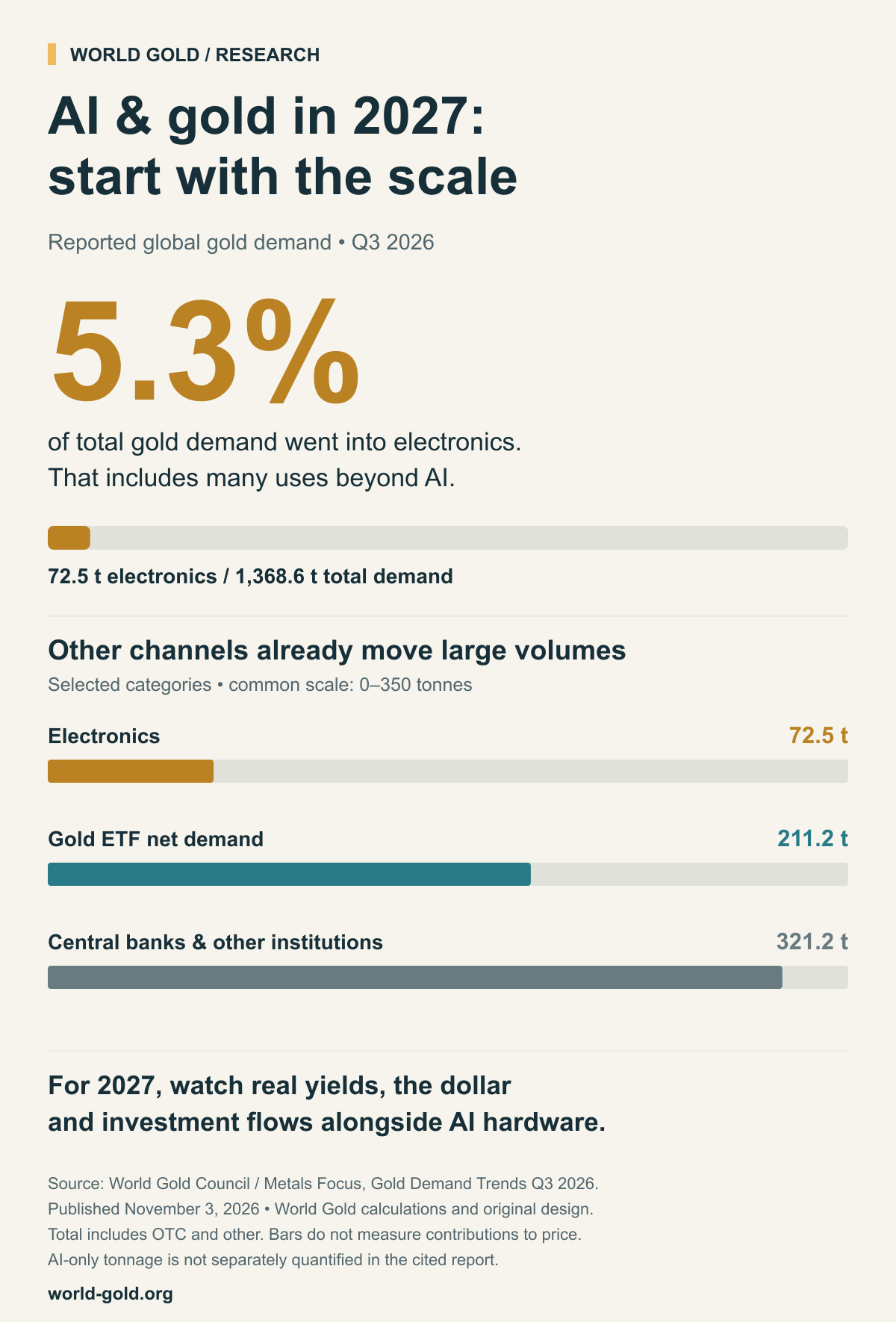
Electronics used 72.5 tonnes of gold in the third quarter of 2026, up from 68.9 tonnes a year earlier. Total technology demand was 84.8 tonnes. Growth in AI-related manufacturing supported gold use even as some producers reduced the amount used in each component or switched materials. World Gold Council technology report.
Electronics represented 5.3% of total quarterly gold demand of 1,368.6 tonnes. All technology represented 6.2%. In the same quarter, gold ETFs and similar products accounted for 211.2 tonnes of net demand, and central banks and other institutions bought 321.2 tonnes. These comparisons show volumes. Estimating the effect on price would require separate evidence. World Gold Council / Metals Focus demand table.
Electronics includes uses beyond AI. The report gives no separate AI tonnage. Estimating it from chip sales or spending on servers would require data on production volumes and how much gold each component uses.
Data centres, electricity costs and inflation
In October 2026 the International Energy Agency projected more than US$700 billion in capital expenditure by the largest data centre operators that year, mostly for new data centres. The figure covers total hyperscaler capex. The IEA also documented pressure on local grids and equipment supply, alongside long waits to connect new projects. IEA, Powering Artificial Intelligence.
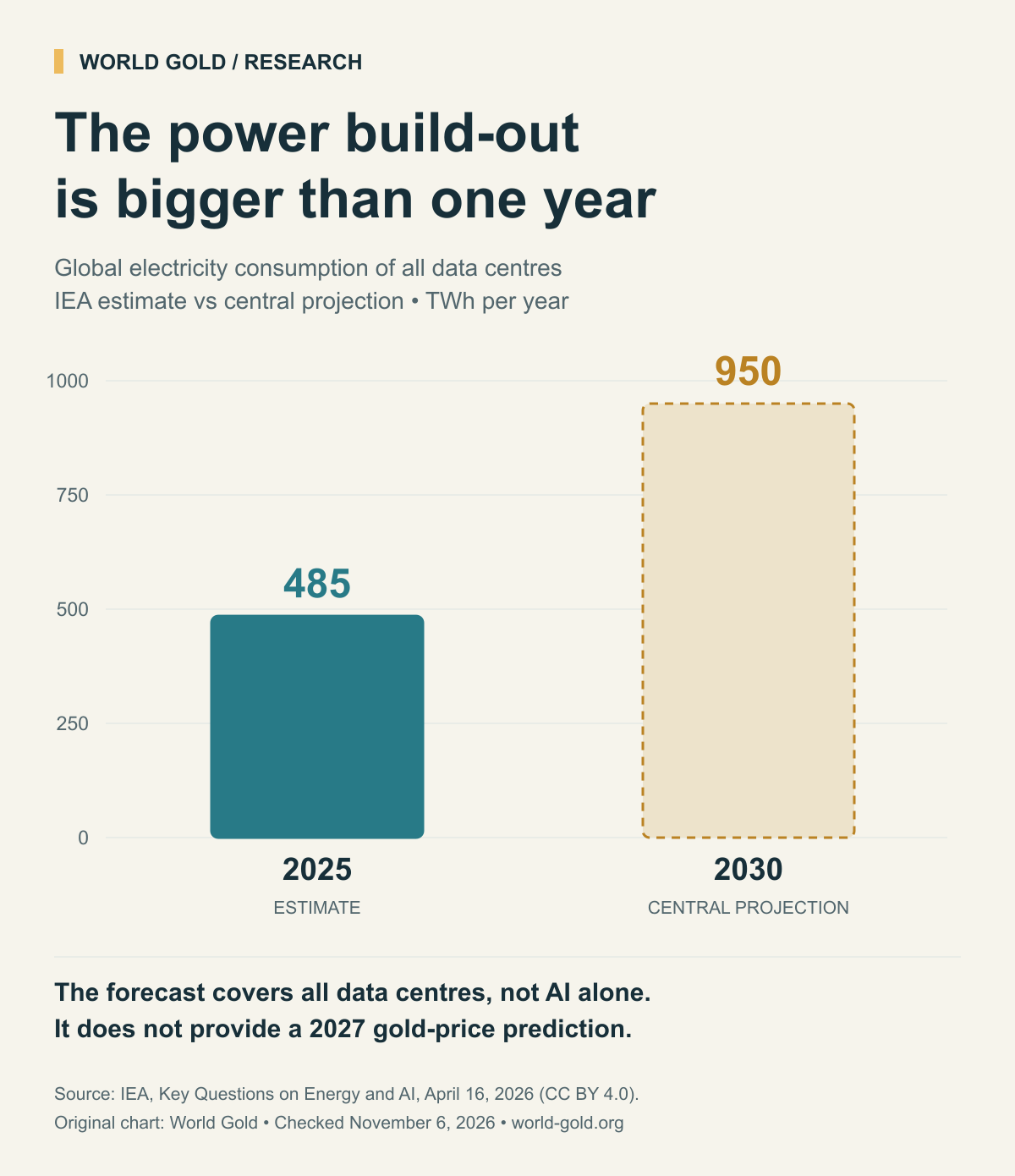
The IEA estimated that data centres worldwide used 485 TWh in 2025 and projected 950 TWh in 2030 in its central case. The two figures cover all data centres. Their effect on broader inflation depends on where power demand rises, how quickly generation and grids expand, and how electricity prices are set. For gold, what matters is how inflation expectations and monetary policy respond. IEA, Key Questions on Energy and AI.
AI could also change gold production
In September 2026 Avathon announced that Barrick’s North American gold business had selected its platform for work including processing, maintenance, mine planning and exploration. Better recovery or less downtime could increase output from existing mines. The vendor announcement describes intended uses. It gives no estimate of additional ounces already produced. Avathon announcement.
Real yields and the dollar could outweigh the hardware effect
If expected inflation falls while nominal yields stay unchanged, real yields rise. If nominal yields fall by more, real yields can fall instead. Higher real yields make it more costly to hold an asset that pays no interest. A stronger dollar can also put pressure on gold’s USD price. The World Gold Council’s Q3 outlook weighs rates and the dollar against fiscal concerns, inflation risks and financial stress. World Gold Council Q3 2026 outlook.
A rise in productivity could also change growth and the interest rate consistent with economic balance. New York Fed researcher Simone Lenzu sets out how AI could influence the economic cycle, long-run growth and financial stability, with different implications for policy. New York Fed Staff Report 1192.
Gold could fall at first in an AI sell-off
The IMF flagged a possible correction in AI-related assets if investment or profits disappoint. Borrowing and concentrated positions could amplify the move. During an urgent scramble for cash, investors may sell liquid assets including gold, as the World Gold Council documented in March 2020. If stress later brings lower real yields or sustained reallocations into gold, those shifts could support its price. A stronger dollar or persistent inflation could complicate that path. IMF Global Financial Stability Report, October 2026 · World Gold Council on March 2020.
Three scenarios for gold in 2027
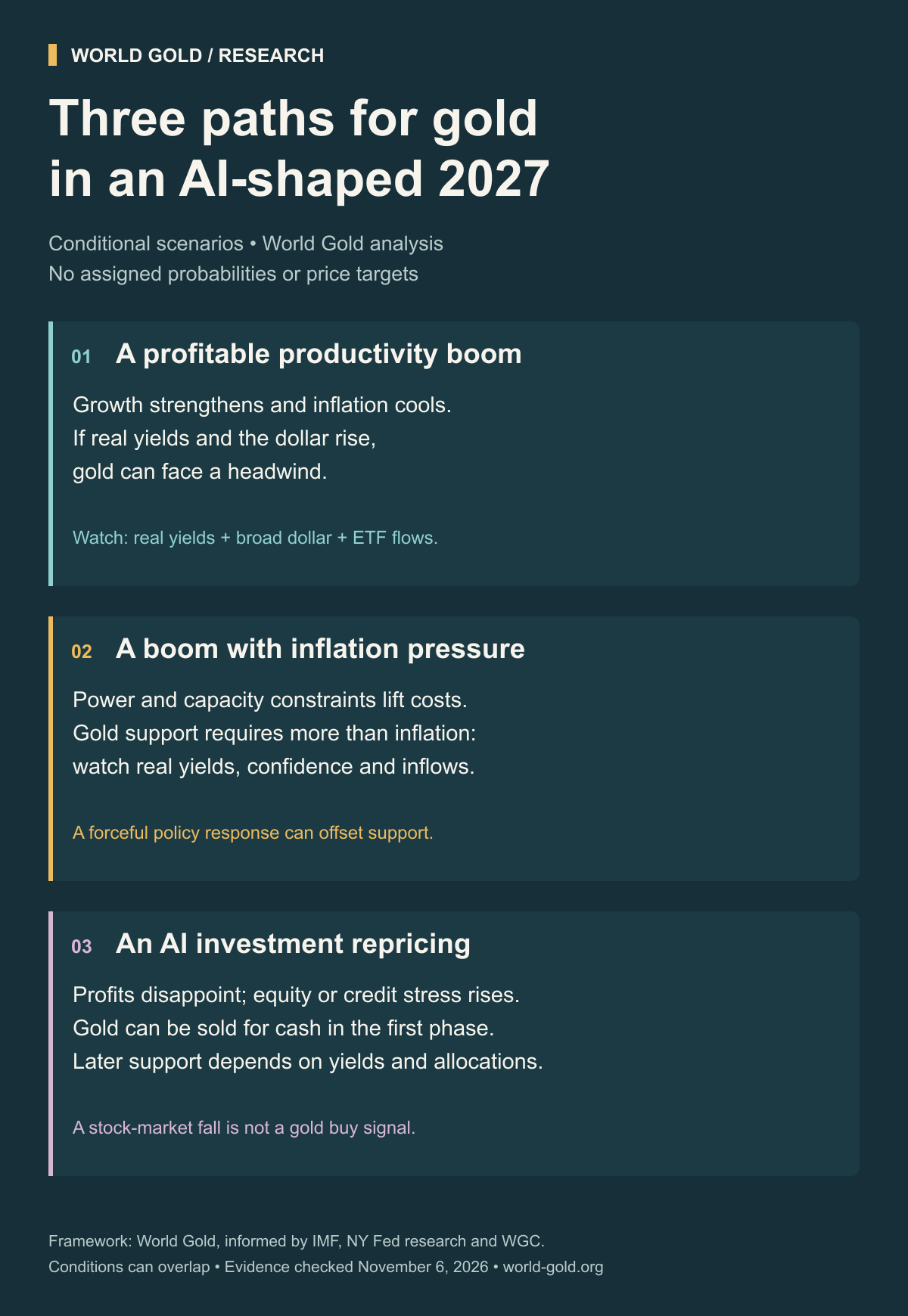
Each scenario describes conditions to watch in calendar 2027. The scenarios can overlap. We assign no probabilities or price targets.
1. A profitable AI boom weighs on gold
Rising profits alongside higher real yields, a stronger dollar and weak gold inflows would fit this scenario. Falling real yields or growing gold allocations would weaken it, even if growth remains strong.
2. Power constraints and inflation concerns support gold
Persistent inflation concerns could support gold if real yields fall, confidence weakens and money flows into gold. Rising real yields, well-anchored inflation expectations or easing power constraints would weaken this case.
3. An AI correction changes demand for protection
Widening credit stress followed by sustained gold inflows and lower real yields would support this scenario. Contained stress, persistent dollar strength or continued selling for cash would weaken it.
What to watch in 2027
Real yields and the dollar. The 10-year inflation-indexed Treasury yield measures the market’s real yield. Use the broad trade-weighted dollar index to track dollar strength across U.S. trading partners. FRED real yield (DFII10) · FRED broad dollar (DTWEXBGS).
Gold allocations and industrial demand. Compare ETF flows, official-sector buying and electronics use over matching periods. Growing electronics output can coincide with manufacturers using less gold per component. World Gold Council demand reports · Technology report.
Capex and power connections. Check which projects become operational. When comparing companies, match reporting periods and check whether spending figures include leases. IEA power and data centre analysis.
Central-bank reserve decisions, fiscal policy, geopolitics, jewellery demand, recycling and mine supply can all move the gold market independently of AI. The best test of the AI story is whether changes in yields, the dollar and gold allocations line up with the proposed mechanism.
Sources and methodology
World Gold combines published demand estimates, energy projections, research and company disclosures. The electronics share is 72.5 ÷ 1,368.6 × 100, rounded to one decimal place. The denominator includes OTC and other demand. Electronics is part of technology demand. The electricity chart compares the IEA’s two published endpoints without interpolating a value for 2027.
The gold chart uses limited statistics from World Gold Council / Metals Focus for editorial commentary. The IEA figures are attributed under CC BY 4.0. World Gold designed the graphics and developed the scenarios.
- World Gold Council / Metals Focus — Gold Demand Trends Q3 2026 · 2026-11-03
- World Gold Council — Q3 2026 technology demand · 2026-11-03
- World Gold Council — The AI boom and gold · 2026-09-24
- IEA — Key Questions on Energy and AI · 2026-04-16
- IEA — Powering Artificial Intelligence · 2026-10-14
- Simone Lenzu — Artificial Intelligence and Monetary Policy, NY Fed Staff Report 1192 · 2026-04
- World Gold Council — Q3 2026 outlook · 2026-11-03
- IMF — Global Financial Stability Report, October 2026 · 2026-10-13
- World Gold Council — Gold prices swing as markets sell off · 2020-03-19
- FRED / Federal Reserve Board — 10-year inflation-indexed Treasury yield (DFII10) · Ongoing series
- FRED / Federal Reserve Board — Nominal Broad US Dollar Index (DTWEXBGS) · Ongoing series
- Avathon — AI operating-model partnership with Barrick North America · 2026-09-23